
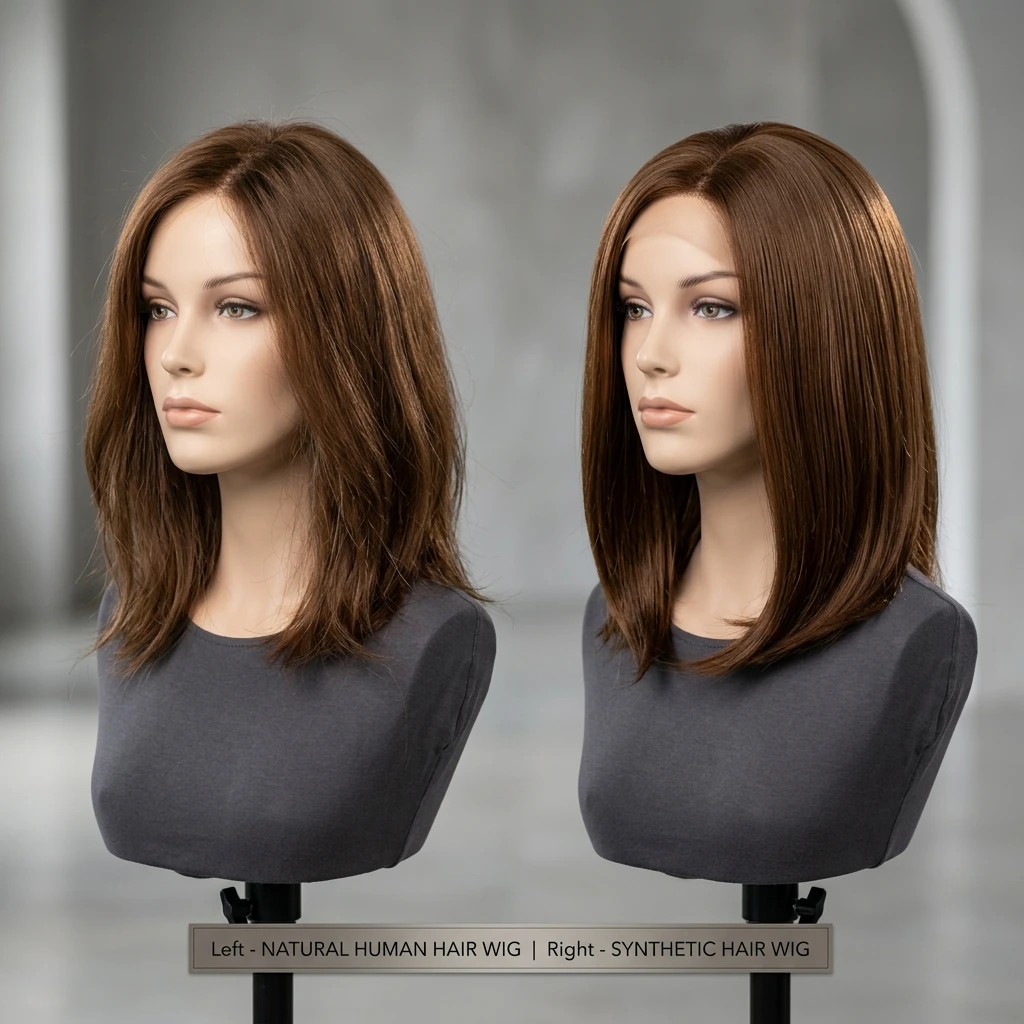
Human Hair vs Synthetic Wigs: Which One Should You Buy?
You have a $200 wig sitting in your cart, and the question is no longer whether you like the color or length. It is whether the material will actually fit the way you live.
Human hair and synthetic wigs can both look convincing. The bigger difference is what happens after you put the wig on: how much styling freedom you have, how predictable the shape remains, how often you need to maintain it, how it handles weather, and whether the purchase still feels worthwhile months later.
Hero takeaway: Human hair generally gives you more flexibility and a more natural styling experience, while synthetic hair generally gives you better style memory and easier day-to-day upkeep. Neither material wins every category.
If you are still deciding on construction, cap design, color, length, or lace, start with the broader Wig Buying Guide, then use the comparison below to narrow down the material.
Quick Answer: Human Hair Wins for Versatility, Synthetic Wins for Convenience
If your priority is maximum styling flexibility, realistic movement, and the ability to change the look over time, human hair is usually the stronger choice. If your priority is easy maintenance, predictable shape, and a style that is ready to wear with minimal work, synthetic hair may be the more practical choice.
A useful shortcut is to think of the decision as flexibility vs. predictability. Human hair behaves more like your own hair: it can respond to heat, brushing, products, humidity, and styling. Synthetic fibers are engineered to hold a predetermined shape, so the same features that limit styling can make daily wear easier.
For many first-time buyers, a 16–18 inch lace-front wig with medium density and a straight or body-wave texture offers a balanced starting point. The best material still depends on how often you wear the wig, how much styling you do, your climate, and your expected ownership period.
Quick Verdict: Choose human hair when styling freedom, natural movement, and long-term versatility matter most. Choose synthetic when predictable styling, lower maintenance, and convenience matter more. Buyers who regularly restyle their wigs should generally lean toward human hair; buyers who want a consistent ready-to-wear shape may prefer synthetic. Neither choice is automatically more natural-looking because lace quality, density, hairline construction, color, fit, and installation all affect the final result.
Default Best Recommendation: A 16–18 Inch Human-Hair Lace Front Is the Most Flexible Starting Point
For a buyer who wants one versatile everyday wig rather than a specialized piece, a 16–18 inch human-hair lace front with medium density and a straight or body-wave texture is a sensible default.
That combination does not mean it is the right choice for everyone. It simply avoids several common extremes while leaving room for personalization.
Why This Combination Works
The length is versatile. Sixteen to eighteen inches can look polished without creating the maintenance burden associated with very long hair.
A lace front creates styling options. It can provide a more natural-looking front hairline while allowing some flexibility in parting and styling.
Medium density balances realism and fullness. Very high density can look dramatic but may require more thinning or styling to appear natural.
Straight and body-wave textures are relatively adaptable. They can work for casual, professional, or dressed-up looks and are generally easier to modify than highly specialized textures.
Human hair provides future styling choices. The same wig can potentially be worn straight, waved, curled, or restyled according to the construction and the condition of the hair.
The combination makes the material difference easier to evaluate. If you are unsure whether human hair is worth the premium, a moderately sized everyday style gives you a practical test of its flexibility without paying for extreme length or density.
What to Avoid When You Want a Low-Regret First Purchase
Extremely long lengths if you do not want frequent detangling and conditioning.
Very high density simply because it looks impressive in product photos.
A lace type chosen only because it is labeled “HD” without checking the actual hairline and cap construction.
A texture that requires styling techniques you do not realistically want to perform.
Human Hair vs Synthetic Wigs at a Glance
| Factor | Human Hair | Synthetic Hair | What It Means for Your Decision |
|---|---|---|---|
| Natural movement | Usually more fluid | Depends strongly on fiber quality | Human hair can have a more hair-like response |
| Styling flexibility | High | Limited, especially with standard fibers | Human hair suits frequent restyling |
| Style memory | Low to moderate | Usually high | Synthetic is convenient for consistent looks |
| Maintenance | More involved | Usually easier | Synthetic can save time |
| Heat styling | Generally possible with appropriate care | Depends on fiber type | Check manufacturer specifications before applying heat |
| Longevity | Can be long with good care | Often shorter, depending on wear and fiber | Frequent wear can favor human hair |
| Upfront price | Usually higher | Usually lower | Compare expected use, not just purchase price |
| Humidity response | Can change like natural hair | Often more predictable | Climate matters |
| Customization | High | More limited | Human hair offers greater personalization |
| Ready-to-wear convenience | Moderate | High | Synthetic can be easier for busy routines |
The important point is that these are behavioral differences, not a simple good-versus-bad ranking. A buyer who values predictable styling may genuinely prefer the characteristic that another buyer considers a limitation.
The Core Decision Is Flexibility vs. Predictability
The easiest way to understand the human-hair versus synthetic-wig decision is to ask what you want the material to do.
Human hair gives you a broader range of possible outcomes. You can potentially change the texture, reshape the style, alter the part, or create a different finish. That flexibility is valuable when you see a wig as a reusable styling platform.
Synthetic hair is designed around a different idea. Its fibers are commonly manufactured to hold a particular pattern. A curly synthetic wig can retain its curl pattern after washing, while a straight synthetic wig can remain relatively consistent without the same styling routine required by human hair.
This creates a useful distinction:
Human hair = more control over the final look.
Synthetic hair = more consistency in the intended look.
Neither statement means every human-hair wig will outperform every synthetic wig. Fiber quality, construction, density, hair processing, lace, cap fit, and maintenance all influence the result.
- Fact Block: Human Hair Styling Flexibility
Fact: Human hair generally offers substantially more styling flexibility than standard synthetic fibers because it can be manipulated more like natural hair. Heat, chemical processing, brushing, and repeated styling can still cause damage, so flexibility does not mean unlimited durability.
Human Hair Gives You More Styling Freedom, While Synthetic Gives You Better Style Memory
“Style memory” describes a fiber's ability to return to or retain its designed shape after routine wear or washing.
This is one of synthetic hair's most useful characteristics.
Imagine you own a synthetic body-wave wig. You wash it according to its care instructions, allow it to dry, and the wave pattern can return with relatively little styling. With human hair, washing can remove the existing shape, meaning you may need to blow-dry, curl, straighten, or otherwise restyle the hair.
That creates two different kinds of convenience.
Synthetic convenience: less daily styling.
Human-hair convenience: more freedom when you want a different style.
When Human Hair Can Make More Sense
Human hair can make more sense when you:
Change hairstyles frequently.
Want to use a flat iron or curling tool where appropriate.
Want to create different parts or finishes.
Prefer natural movement rather than a fixed pattern.
Expect to wear one wig repeatedly over a longer period.
Are comfortable investing time in washing, conditioning, detangling, and restyling.
When Synthetic May Be the More Practical Choice
Synthetic may be the more practical choice when you:
Want a consistent curl or wave pattern.
Prefer a low-effort morning routine.
Do not plan to heat-style the wig.
Need a lower initial purchase price.
Want a specific look that does not need frequent modification.
Prefer predictable performance over maximum customization.
Natural-Looking Results Depend on More Than Human Hair
A common buying mistake is assuming human hair automatically looks more natural.
Material matters, but it is only one part of the visual equation.
A poorly constructed human-hair wig with excessive density, an unnatural hairline, an oversized cap, or an obvious lace transition can look less realistic than a well-made synthetic wig with a convincing fiber, suitable density, and good fit.
The main variables are:
Hairline construction
- Lace quality
- Density
- Knot visibility
- Parting design
- Cap fit
- Texture
- Color and dimension:Installation and wear technique
Lighting and viewing distance
Fact Block: What Actually Creates a Natural-Looking Wig
Fact: Natural-looking results depend on the interaction of hairline construction, density, lace, color, texture, cap fit, and installation—not simply whether the hair is human or synthetic.
Hairline Details Can Matter More Than the Material
The front hairline is often one of the first places people notice a wig.
A lace front usually means the lace construction is concentrated across the front hairline, creating the appearance that individual hairs emerge from the scalp. A full lace design extends lace construction farther across the cap, potentially offering more styling and parting flexibility.
HD lace is a very fine lace designed to blend more subtly under suitable conditions. Swiss lace is another fine lace option that can offer a delicate appearance while requiring careful handling because finer lace can be more fragile.
A pre-plucked hairline has been customized so the front edge does not look uniformly dense. This can reduce the “wig-like” appearance, although pre-plucking quality varies.
The best combination is not simply “the thinnest lace possible.” A fragile lace that is difficult to handle may be less useful to a buyer who prioritizes frequent wear.
Lace Construction Comparison
| Construction | Typical Benefit | Potential Trade-Off | Best Fit |
|---|---|---|---|
| Lace Front | Natural-looking front hairline | Less full-cap styling flexibility | Everyday wear |
| Full Lace | More versatile parting and styling | Usually more complex and costly | Buyers who style in multiple directions |
| HD Lace | Very subtle appearance when matched well | Can be delicate | Buyers focused on hairline realism |
| Swiss Lace | Fine, lightweight lace option | Requires careful handling | Buyers seeking a delicate finish |
The goal is to match the construction to your actual use rather than paying for the most technical-sounding specification.
Density Changes How Natural and Full a Wig Looks
Density describes how much hair is ventilated into the wig. Product listings may use percentages such as 130%, 150%, and 180%.
These numbers are useful for comparison within a product line, but they should not be treated as a universal measurement across every manufacturer. A listed percentage does not tell you everything about how the wig will look or feel.
- 130% Density:A 130% density can create a relatively light, natural-looking appearance. It may suit buyers who prefer less bulk, especially for shorter or everyday styles.
The trade-off is that it may not provide the dramatic fullness some buyers expect from longer styles.
- 150% Density:A 150% density is often a useful middle ground. It can provide visible fullness without automatically producing an overly heavy appearance.
For a versatile 16–18 inch everyday wig, this range can be worth considering when the goal is balance rather than maximum volume.
- 180% Density:An 180% density can produce a fuller, more dramatic appearance. It may appeal to buyers who like substantial volume, longer lengths, or highly styled looks.
The additional hair can also increase weight, maintenance, and the amount of customization required to achieve a natural finish.
Density Decision Table
| Your Priority | Density to Consider | Why |
|---|---|---|
| Lightweight, understated appearance | Around 130% | Less visual and physical bulk |
| Balanced everyday fullness | Around 150% | Middle-ground appearance |
| Noticeable volume | Around 180% | Fuller, more dramatic silhouette |
| Very natural front | Medium density + good hairline | Density alone does not create realism |
| Heavy glam styling | Higher density may help | Provides more material for volume |
Texture Changes the Maintenance Equation
Texture should be selected based on both appearance and the amount of work you want to perform.
| Texture | Human Hair | Synthetic | Maintenance Consideration |
|---|---|---|---|
| Straight | Easy to restyle | Often highly predictable | Usually one of the simplest textures to manage |
| Body Wave | Flexible and customizable | Can retain wave pattern well | Good balance between movement and convenience |
| Curly | Can be restyled but needs careful care | Can retain defined curls well | Detangling and shape preservation matter |
| Coily | Highly customizable with the right hair | Can be engineered for consistent definition | Moisture, tangling, and shape retention deserve attention |
A coily texture should not be treated as simply a “curly” style with tighter curls. Its structure, detangling needs, definition, and desired finish can create different maintenance requirements.
Human hair gives you more ability to change texture, but frequent manipulation can reduce longevity. Synthetic texture can be easier when you want the designed curl or coil pattern to remain consistent.
Comfort Depends on Construction, Not Just Fiber
People often compare human hair and synthetic wigs as though the fiber itself determines comfort. In practice, comfort is affected by several components.
Consider:
Cap circumference.
Adjustable straps.
Breathability.
Number and placement of wefts.
Lace coverage.
Overall density.
Wig weight.
Hair length.
How securely the wig is installed.
How long you wear it at one time.
A very dense human-hair wig can feel heavier than a lighter synthetic wig. A lightweight synthetic wig can feel easier for long periods even if the buyer initially assumed human hair would be more comfortable.
The right fit also matters. A cap that is too tight can create pressure regardless of material, while a cap that is too loose may require additional securing.
For longer wear, a breathable cap and correct circumference can be more meaningful than the label on the fiber.
Human Hair vs Synthetic Wigs: Which One Is Easier to Maintain?
Synthetic wigs generally win the maintenance category because their fibers can retain the intended style without repeated heat styling.
That does not mean synthetic wigs are maintenance-free.
They still need:
Gentle detangling.
Proper washing.
Drying in the recommended manner.
Storage that prevents unnecessary friction.
Care around heat and friction.
Periodic inspection of the cap and lace.
Human hair usually requires more active maintenance because it behaves like hair rather than a fixed fiber pattern.
Human Hair Maintenance
A typical care routine can include gentle cleansing, conditioning, careful detangling, controlled drying, and occasional restyling.
The ends may become dry or damaged over time, particularly with frequent heat exposure. Product buildup can also affect the finish.
The advantage is that you have more options for restoring or changing the style.
Synthetic Maintenance
Synthetic hair generally benefits from minimal manipulation. Excessive heat can damage standard synthetic fibers, and even heat-friendly fibers have manufacturer-specific limits.
A synthetic wig can be particularly convenient for buyers who want to wash it, let the designed shape return, and avoid rebuilding the hairstyle every morning.
- Fact Block: Synthetic Style Retention Advantage
Fact: Standard synthetic fibers are commonly designed to retain a predetermined shape, which can reduce the need for daily restyling. That predictability is one of the main reasons synthetic wigs can be attractive to low-maintenance buyers.
Weather Changes the Value Equation
Climate can influence which material feels more useful.
Humidity can affect human hair because it responds to moisture in ways similar to natural hair. A style that looked smooth indoors can develop additional texture or volume in humid conditions.
Synthetic hair can offer more predictable shape retention, although the exact response varies by fiber and construction.
Heat also changes the comfort calculation. A dense wig may feel warmer regardless of material, while a lighter cap and lower density may improve airflow.
If you live in a humid climate and want a highly controlled straight style, synthetic may be appealing because of its predictability. If you are comfortable with natural movement and want the option to restyle after weather changes, human hair may offer greater flexibility.
Human Hair and Synthetic Wig Pros and Cons
- Human Hair Pros:Natural movement.
High styling flexibility.
Broad customization potential.
Can be restyled repeatedly with appropriate care.
Often a strong option for frequent wear.
Can feel more like natural hair during styling.
- Human Hair Cons:Higher upfront cost.
More maintenance.
Can respond to humidity.
Heat and chemical processing can cause damage.
Quality varies significantly between products.
Requires more effort to preserve the original condition.
- Synthetic Wig Pros:Usually lower upfront cost.
Predictable style retention.
Often easier for daily wear.
Minimal restyling required.
Useful for consistent curls, waves, or straight styles.
Can be convenient for buyers with limited styling time.
- Synthetic Wig Cons:Standard fibers have limited heat-styling flexibility.
Some fibers can look less natural at close range.
Friction can affect the ends and surface.
Style changes are more restricted.
Frequently worn synthetic wigs may show wear depending on fiber quality and care.
The fixed style can become a limitation when your preferences change.
When Human Hair Is Not the Better Choice
Human hair can be a poor value when:
You rarely plan to style the wig differently.
You mainly want a consistent ready-to-wear shape.
Your budget is tightly constrained.
You dislike washing, conditioning, and restyling.
You need a wig specifically because you do not want to manage hair each morning.
You would rather own several lower-cost styles than one higher-cost piece.
In these situations, paying extra for flexibility you will not use does not necessarily improve the ownership experience.
When Synthetic May Be the Wrong Choice
Synthetic may be the wrong fit when:
You want to heat-style your wig frequently.
You regularly switch between straight, wavy, and curly looks.
You want extensive customization.
You expect one wig to serve many different styling purposes.
You prefer natural hair movement over fixed shape retention.
You are comfortable paying more to gain longer-term styling flexibility.
The key question is not “Which material is better?” It is “Which material gives me the capabilities I will actually use?”
The Real Cost Is Price Per Wear, Not Just the Checkout Price
A $200 synthetic wig and a $700 human-hair wig look dramatically different on a price tag.
But price alone does not measure value.
A simple price-per-wear calculation can make the comparison more useful:
Price per wear = purchase price ÷ realistic number of wears
For example, imagine:
Synthetic wig: $200 ÷ 30 wears = about $6.67 per wear.
Human-hair wig: $700 ÷ 120 wears = about $5.83 per wear.
These are hypothetical examples, not expected lifespan guarantees. Actual wear count depends on construction, frequency, maintenance, installation, friction, storage, and individual handling.
The calculation also leaves out your time. If a human-hair wig requires substantial restyling before every wear and you value your time highly, the financial comparison does not capture the full cost.
A Better Value Formula
Think about the purchase as:
Value = usable wear life + styling flexibility + convenience + appearance + comfort − maintenance burden
Different buyers assign different weights to each category.
A commuter who needs a predictable style may assign convenience a high value. A buyer who changes hairstyles several times a week may assign flexibility a high value.
That is why a more expensive wig can be a better value for one person while a lower-priced wig is the better purchase for another.
A User Profile Decision Matrix Makes the Choice Easier
| Buyer Profile | Better Starting Point | Main Reason |
|---|---|---|
| Frequent restyler | Human hair | Greater styling freedom |
| Minimal-maintenance buyer | Synthetic | Strong style retention |
| First-time buyer on a limited budget | Synthetic | Lower initial commitment |
| Long-term frequent wearer | Human hair | Potentially stronger long-term value |
| Buyer who loves fixed curls | Synthetic | Consistent curl pattern |
| Buyer who changes textures | Human hair | Greater versatility |
| Humid-climate buyer seeking predictable styling | Synthetic may fit | Less styling variation |
| Buyer who embraces natural movement | Human hair | Hair-like response |
| Professional with limited morning time | Synthetic may fit | Less restyling |
| Buyer who wants one adaptable wig | Human hair | More styling options |
This matrix is a starting point rather than a rule. Product quality can outweigh material category in some cases.
A Second Decision Matrix Helps With Construction and Specs
| Priority | What to Look For | Why It Matters |
|---|---|---|
| Natural front hairline | Lace front + appropriate density | Reduces an overly uniform front |
| Maximum parting flexibility | Full lace | Allows more styling directions |
| Delicate lace appearance | HD or Swiss lace | Can create a subtle transition |
| Everyday balance | Medium density | Balances fullness and weight |
| Lightweight appearance | Around 130% | Lower density can reduce bulk |
| Fuller glam appearance | Around 180% | Provides more visual volume |
| Flexible everyday style | Straight or body wave | Broad styling potential |
| Defined texture with low restyling | Synthetic curl or coil | Style memory can be useful |
| Frequent heat styling | Human hair or approved heat-friendly fiber | Check product-specific heat limits |
| Long wear sessions | Breathable cap + proper fit | Comfort depends heavily on construction |
| Common Mistakes Buyers Make When Comparing Wig Materials |
- Comparing Material Before Comparing Construction
A high-quality synthetic lace front can be a better purchase than a poorly constructed human-hair wig.
- Look at the entire product: hairline, lace, density, cap, knots, texture, and fit.
- Assuming Higher Density Means Better Quality
More hair is not automatically more realistic.
A very dense wig can look heavy at the hairline and require customization. Lower or medium density can sometimes create a more understated finish.
- Buying HD Lace Without Considering Durability
HD lace can provide a subtle appearance, but extremely fine lace may require more careful handling.
If you wear a wig frequently, the best lace may be the one that balances appearance with the amount of handling you expect.
- Ignoring the Actual Texture You Want
A buyer may spend more for human hair and then discover that most of their time is spent recreating a specific style.
If you love a fixed curl pattern and rarely change it, synthetic may offer a simpler experience.
- Choosing Length Before Thinking About Maintenance
Longer hair generally means more hair to detangle, wash, condition, dry, and protect.
If you want an everyday wig, consider whether the length you admire in a product photo matches the routine you actually want.
Face Shape Matters, but It Should Not Override Personal Preference
Face shape can help narrow your options, but it should not become a rigid set of rules.
Think about silhouette instead:
Rounder-looking faces: longer layers or vertical movement can create a lengthened visual effect.
Longer-looking faces: waves, side volume, or balanced layers can add width.
Angular features: softer waves or rounded movement can create contrast.
Balanced proportions: many lengths and textures can work, making personal preference more important.
Hairline placement, part position, volume distribution, and length can all change how a wig interacts with your features.
If you are uncertain, use a visual preview before buying. Try it on with AI can help you compare lengths, textures, and overall silhouettes before committing.
Actual appearance results vary based on skin tone, lighting conditions, face shape, head size, and individual wear technique. AI try-on previews are for visualization guidance only.
Color and Texture Should Be Evaluated Together
Color does not exist independently from texture.
A straight dark wig can reflect light differently from a body-wave or curly wig. Highlights can appear softer or more pronounced depending on how the texture separates the hair.
If color is your main concern, you can also compare the dedicated Black Wig Buying Guide, Blonde Wig Buying Guide, and Brown Wig Buying Guide .
If the hairline is your main concern, the Lace Front Wig Buying Guide provides a more construction-focused path.
The goal is to avoid evaluating one specification in isolation. A color that looks perfect in a product image can produce a very different impression when combined with a different density, texture, or lace construction.
How to Evaluate a Human-Hair Wig Before Buying
Do not stop at “100% human hair.”
Look for details about:
Hair origin, if disclosed.
Whether the hair is Remy.
Hair direction and cuticle alignment, if specified.
Processing level.
Density.
Lace type.
Cap construction.
Length.
Texture.
Adjustable features.
Return policy.
Care instructions.
Remy hair generally refers to hair collected with the cuticles aligned in a consistent direction. That can support smoother behavior and reduce tangling, although the term alone does not guarantee a particular level of quality.
A product description that gives detailed construction information is more useful than one that relies entirely on broad marketing claims.
How to Evaluate a Synthetic Wig Before Buying
Synthetic buyers should pay close attention to the fiber type and the intended use.
Ask:
Is it standard synthetic fiber?
Is it heat-friendly?
What heat range does the manufacturer specify?
Is the texture designed to return after washing?
How dense is the wig?
Is the hairline lace front or another construction?
Does the cap provide enough ventilation?
Are replacement or care instructions available?
Never assume a synthetic wig is heat-safe simply because it looks like human hair. Fiber behavior varies, and exceeding the manufacturer's stated heat limits can permanently damage a synthetic wig.
The Best Material Depends on How Often You Wear the Wig
Frequency changes the decision.
- Occasional Wear:For occasional events, travel, or experimenting with a new look, synthetic can be attractive because the initial cost may be lower and the style can remain predictable between uses.
Human hair can also make sense if you want to use the same wig for multiple looks across different events.
Several Times Per Week
Frequent wear makes fit, maintenance, durability, and price per wear more important.
If you repeatedly restyle your wig, human hair's flexibility becomes more valuable. If you repeatedly wear the same fixed style, synthetic's convenience can become more valuable.
- Near-Daily Wear:For near-daily use, evaluate the entire system rather than focusing only on fiber.
Cap comfort, density, lace durability, maintenance requirements, storage, and fit all become significant.
A premium human-hair wig is not automatically the best everyday choice if its density is too high, its cap is uncomfortable, or its maintenance routine does not fit your schedule.
AI Try-On Is Best Used as a Screening Tool, Not a Final Guarantee
An AI try-on can be useful before purchase because it helps answer visual questions that product photos cannot answer easily.
You can compare:
Short versus medium length.
Straight versus body wave.
Different colors.
Different part placements.
Higher versus lower visual volume.
Different silhouettes around your face.
Use Try it on with AI as an early screening step: eliminate styles that clearly do not suit the look you want, then inspect the actual product specifications before purchasing.
- Fact Block: AI Try-On Visual Screening
Fact: AI try-on is most useful for comparing visual direction—such as length, color, texture, and silhouette. It cannot reliably predict the exact physical fit, lace blending, density, weight, or final appearance under every lighting condition.
Actual appearance results vary based on skin tone, lighting conditions, face shape, head size, and individual wear technique. AI try-on previews are for visualization guidance only.
A Practical Five-Step Buying Process Step 1: Decide How Much Styling Freedom You Need
If you want one fixed style, synthetic may be enough.
If you want one wig to support multiple hairstyles, human hair becomes more compelling.
Step 2: Choose Your Everyday Length
For a versatile starting point, 16–18 inches is a useful range to consider.
Shorter lengths can reduce maintenance. Longer lengths can create more dramatic silhouettes but require additional care.
Step 3: Choose Density Based on Your Desired Silhouette
Consider approximately 130%, 150%, or 180% according to the amount of fullness you want.
Do not choose the highest percentage simply because it sounds more substantial.
Step 4: Evaluate Hairline and Cap Construction
Look at lace front versus full lace, HD versus Swiss lace, pre-plucked hairlines, cap circumference, and ventilation.
A good material inside a poorly fitting cap can still produce a disappointing result.
Step 5: Calculate Price Per Wear
Estimate how often you realistically expect to use the wig and compare the expected ownership period with the upfront price.
Then add the maintenance time you are willing to spend.
Final Buying Decision: Which One Should You Buy?
Choose human hair if your top priorities are:
Styling flexibility.
Natural movement.
Frequent restyling.
Long-term versatility.
Customization.
One adaptable wig rather than many fixed styles.
Choose synthetic if your top priorities are:
Lower upfront cost.
Consistent style.
Minimal restyling.
Easy daily maintenance.
Predictable curls, waves, or straightness.
Convenience.
If you are still split between the two, start with your routine rather than your budget.
Ask yourself:
“Do I want my wig to adapt to me, or do I want my wig to stay the same for me?”
If you want it to adapt, human hair has the stronger case.
If you want it to stay consistent, synthetic may be the better fit.
For buyers who want a flexible everyday option, a 16–18 inch human-hair lace front with medium density and a straight or body-wave texture remains a balanced starting point. Before purchasing, use AI try-on to screen the overall silhouette, then verify the actual product's cap, lace, density, texture, and care specifications.
Frequently Asked Questions About Human Hair vs Synthetic Wigs
- Is human hair better than synthetic hair?
Not universally. Human hair generally offers greater styling flexibility and natural movement, while synthetic hair often offers easier maintenance and stronger style retention. The better choice depends on how you plan to wear and maintain the wig.
- Do human-hair wigs look more natural than synthetic wigs?
They can, but the material is only one factor. Lace quality, density, hairline construction, cap fit, texture, color, and installation all affect how natural a wig looks. A well-constructed synthetic wig can look more convincing than a poorly constructed human-hair wig.
- Are synthetic wigs good for everyday wear?
They can be. A synthetic wig may be especially convenient for everyday wear when you prefer a consistent style and do not want to restyle the hair frequently. Comfort and durability depend on the specific cap, fiber, density, and care routine.
- Can you curl a synthetic wig?
It depends on the fiber. Standard synthetic fibers generally should not be exposed to high heat. Some heat-friendly synthetic wigs are designed for controlled heat styling, but the manufacturer's specifications should be followed.
- Can you straighten a human-hair wig?
Human hair can generally be straightened with appropriate heat tools and heat protection, provided the wig's construction and condition support it. Repeated heat exposure can still cause damage, so styling flexibility should not be confused with unlimited heat resistance.
- How long does a human-hair wig last?
There is no single guaranteed lifespan. Wear frequency, hair quality, construction, maintenance, installation, heat exposure, friction, and storage all affect longevity. A frequently worn, heavily styled wig will experience different wear from an occasionally worn wig.
- How long does a synthetic wig last?
Synthetic-wig longevity varies by fiber quality, construction, frequency of wear, friction, washing, and maintenance. A wig worn occasionally may remain useful much longer than one worn almost every day.
- Is 150% density good for a wig?
Around 150% can be a useful middle-ground density for buyers who want noticeable fullness without the heavier appearance associated with very high density. The visual result still depends on length, texture, hairline, and the manufacturer's construction.
- What is the difference between 130%, 150%, and 180% density?
They indicate different levels of hair fullness within a product's density system. Around 130% is generally lighter, around 150% offers a middle ground, and around 180% creates more fullness. Percentages should be compared within the same manufacturer's product range rather than treated as perfectly standardized measurements.
10. Is HD lace better than Swiss lace?
Neither is automatically better. HD lace is designed to be very fine and subtle, while Swiss lace is also a fine lace option with its own balance of appearance and durability. The best choice depends on the finish you want and how carefully you can handle the lace.
11. Is a lace front better than a full-lace wig?
A lace front can be a strong everyday option when you mainly want a realistic front hairline. Full lace can provide greater styling and parting flexibility because lace extends farther across the cap. Your preferred hairstyles should determine which construction has more value.
12. Is a pre-plucked hairline worth it?
It can reduce the work required to create a less uniform-looking hairline. However, the quality of pre-plucking varies. A pre-plucked label should not replace checking photos, density, lace, and the actual hairline construction.
13. Which is better for humid weather, human hair or synthetic?
Synthetic may be appealing when your priority is maintaining a predictable style because many synthetic fibers are designed to retain their shape. Human hair can respond to humidity more like natural hair. However, the best choice also depends on the texture and style you want.
14. Which wig is easier to maintain?
Synthetic wigs are generally easier when you want to preserve one designed style. Human-hair wigs usually require more washing, conditioning, drying, detangling, and restyling. The trade-off is that human hair provides greater styling freedom.
15. Is a human-hair wig worth the extra money?
It can be worth the premium if you will actually use its flexibility, wear it frequently, or keep it long enough for price per wear to become favorable. If you rarely restyle your wig, a less expensive synthetic option may provide better practical value.
16. Should a first-time wig buyer choose human hair or synthetic?
A first-time buyer who wants low maintenance and a fixed style may find synthetic easier. Someone who wants to learn styling and eventually create multiple looks may prefer human hair. A moderate-length lace front with medium density can make either material easier to evaluate.
17. Can synthetic wigs look realistic?
Yes. Realism depends on the fiber, hairline, lace, density, color, cap construction, and styling. A high-quality synthetic wig can produce a convincing appearance, particularly when the fiber and construction are well matched to the desired style.
18. Should I use AI try-on before buying a wig?
It can be useful as a visual screening step. AI try-on can help compare length, color, texture, and overall silhouette, but it cannot guarantee physical fit or exact lace blending. Use Try it on with AI alongside the product's actual specifications.
Research Method and Editorial Standards
This comparison was prepared by the TryOnWigs Research Team using an analysis of 15+ major wig brands and 50+ product listings.
The review framework considered wig construction, density, lace type, pricing, styling flexibility, texture, maintenance requirements, cap design, and common use cases. Product specifications were compared at the category level rather than treating one manufacturer's marketing language as a universal standard.
Because wig quality varies considerably between sellers and product lines, this article focuses on decision principles that remain useful across different products. Individual product specifications should always be checked before purchase.
This article is intended for consumer education and shopping guidance. It does not replace product-specific care instructions from the manufacturer.
Final Takeaway: Buy for the Routine You Actually Want
The human-hair versus synthetic-wig debate becomes much easier when you stop asking which material is universally superior.
Human hair is strongest when you value flexibility. It gives you more freedom to change texture, shape, and styling direction, and it can provide a more natural response during styling.
Synthetic hair is strongest when you value predictability. It can hold a designed shape with less daily intervention, which can make it especially appealing for buyers who want a reliable ready-to-wear look.
The smartest purchase is therefore not necessarily the most expensive wig or the one with the longest specification list. It is the wig whose material, density, lace, cap, texture, length, and maintenance requirements match your real routine.
For a flexible everyday starting point, consider a 16–18 inch lace-front wig with medium density and a straight or body-wave texture, then decide whether human hair or synthetic better matches your priorities.
If your next question is “Will this particular style actually suit me?”, try it on with AI before making the final purchase decision.
Actual appearance results vary based on skin tone, lighting conditions, face shape, head size, and individual wear technique. AI try-on previews are for visualization guidance only.
👉 Try Online Free
How We Evaluated This Guide (Methodology & Testing Protocols)
- Tear Propagation & Tensile Limits: Evaluated via standard ASTM D2261 & ISO 13937 guidelines;
- Optical Density & Knot Analysis: Microscopic needle-knot inspection across 130%, 150%, and 180% benchmark densities;
- Scalp Tension & Breathability: Real-world wear feedback aggregated across verified buyer test panels.
⚖️ TryOnWigs Editorial Independence & FTC Compliance: We are an independent consumer decision platform. We accept zero sponsored brand placements. Some merchant links may earn standard affiliate commissions at zero cost to you, which fund our independent laboratory teardowns and microscopic fiber testing.